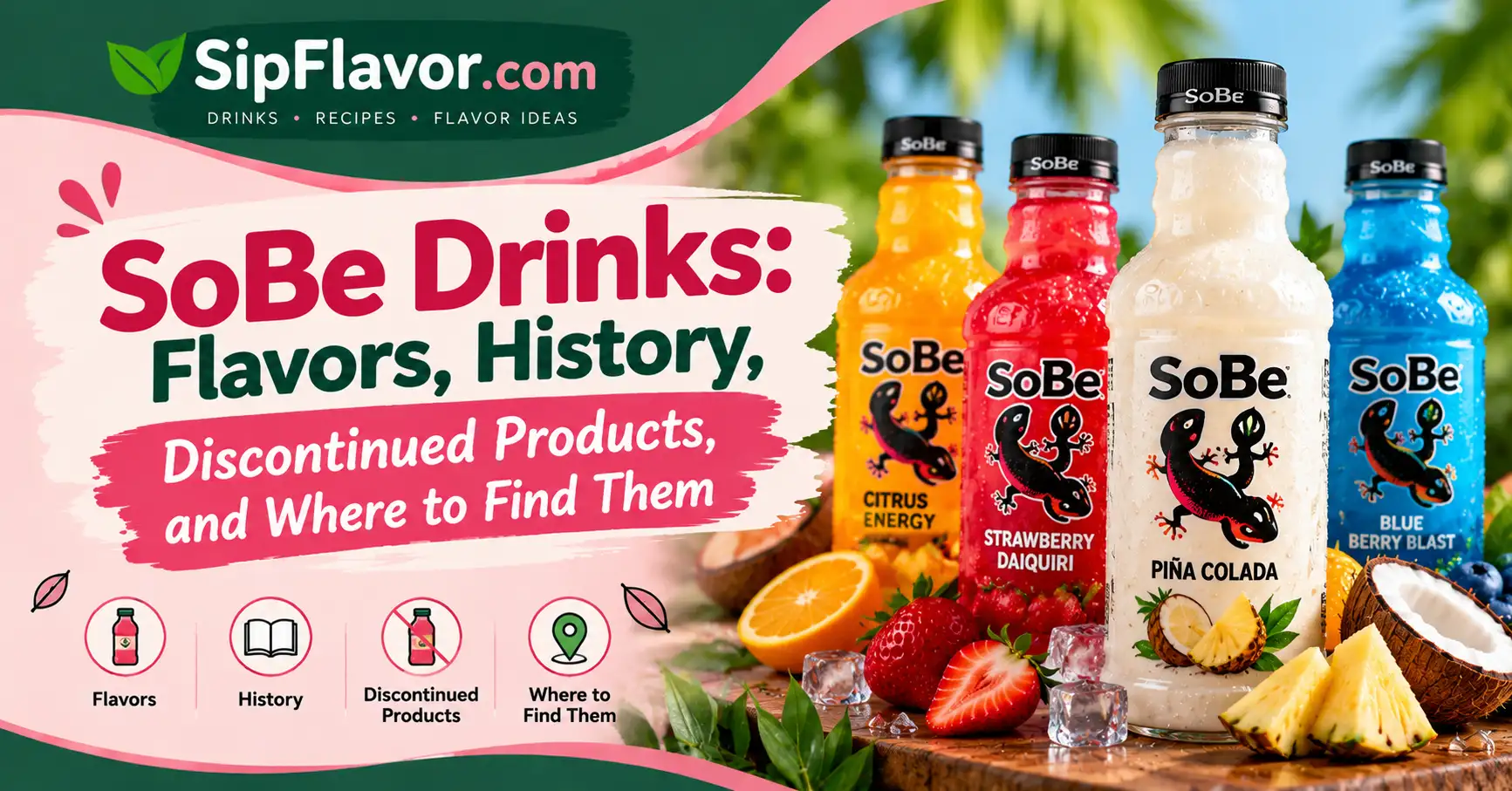
SoBe drinks were once a familiar sight in American convenience stores, supermarkets, and vending machines. Known for their colorful bottles, bold flavors, and distinctive lizard logo, these beverages stood out from ordinary sodas and bottled teas. The brand offered everything from fruity SoBe Elixirs and herbal teas to vitamin-enhanced SoBe Lifewater.
Today, many people search for SoBe drinks because they remember a favorite flavor and want to know whether it still exists. Others want to explore the brand’s history, discover its most popular beverages, or find alternatives that offer a similar taste.
The challenge is that SoBe’s current availability is limited and varies by product. Many once-popular varieties are difficult to find in mainstream U.S. stores, and historical product listings do not necessarily mean a beverage is still being manufactured.
This guide explains what happened to SoBe drinks, which flavors made the brand famous, what ingredients and nutritional differences mattered, and how to look for remaining stock or comparable alternatives.
Quick Answer: What Happened to SoBe Drinks?
SoBe drinks are much harder to find in the United States than they were during their peak popularity. Many of the brand’s classic beverages, including popular Elixirs and Lifewater varieties, have largely disappeared from mainstream retail shelves. However, a definitive public discontinuation date covering every SoBe product is not clearly established.
SoBe began in 1995 and became known for its unusual flavor combinations, herbal ingredients, colorful packaging, and playful branding. Its products included fruity Elixirs, bottled teas, and vitamin-enhanced Lifewater beverages.
If you want to find SoBe drinks today, check the brand’s official product locator, contact local retailers, and verify that any online listing represents genuine, appropriately stored stock. A product page or marketplace listing alone does not guarantee current production or availability.
TL;DR: SoBe Drinks at a Glance
- Brand: SoBe, short for South Beach.
- Founded: 1995.
- Known for: Fruity beverages, herbal teas, Elixirs, Lifewater, and its iconic lizard branding.
- Popular historical flavors: Citrus Energy, Liz Blizz Piña Colada, Orange Carrot Elixir, Strawberry Banana Morning Patrol, and Mango Melon South Beach Sunset.
- Product categories: SoBe Elixirs, SoBe teas, and SoBe Lifewater.
- Are SoBe drinks discontinued? Many classic varieties are no longer readily available in mainstream U.S. retail, but the status of individual products should be checked separately.
- Where to look: The official SoBe product locator, local retailers, and reputable online marketplaces.
- Best substitute: It depends on the flavor you remember. Fruity bottled drinks, herbal teas, vitamin-enhanced waters, and sparkling fruit beverages can each recreate part of the original SoBe experience.
What Are SoBe Drinks?
SoBe is an American beverage brand best known for combining fruit-forward flavors with teas, herbal ingredients, and eye-catching packaging. The name comes from South Beach, the Miami Beach neighborhood associated with the brand’s early identity.
The company launched in 1995 and initially attracted attention with beverages that felt different from conventional soft drinks. Rather than relying on traditional cola flavors, SoBe offered combinations involving fruit, tea, and ingredients such as ginseng and guarana.
The brand’s original positioning emphasized a lively, unconventional image. Its bottles often featured bright colors, a large lizard logo, and flavor names that were memorable even years after the products disappeared from store shelves.
What made SoBe different?
Several characteristics helped establish SoBe’s identity:
- Distinctive flavor combinations: Fruit blends, citrus beverages, tropical flavors, and sweet tea varieties.
- Herbal ingredients: Some products included ingredients such as ginseng and guarana.
- Multiple beverage categories: The range expanded beyond its early teas into Elixirs and Lifewater.
- Recognizable packaging: The lizard logo and colorful labels made the bottles easy to identify.
- Variety of formulations: Depending on the product, beverages could contain sugar, sweeteners, vitamins, tea extracts, or other ingredients.
Not every SoBe drink contained the same ingredients or served the same purpose. A sweet fruit Elixir, a caffeinated tea, and a zero-calorie Lifewater beverage could have substantially different nutritional profiles.
That distinction matters when comparing an old favorite with a modern substitute.
Are SoBe Drinks Discontinued?
Many classic SoBe drinks are effectively discontinued or unavailable through ordinary U.S. retail channels. However, it is important to distinguish between products that are no longer commonly sold and products for which an official discontinuation announcement exists.
Reports about the brand’s disappearance describe once-popular varieties becoming increasingly difficult to find. Several historical product pages have also been retired. These are meaningful signs of reduced availability, but they do not establish a single confirmed discontinuation date for every product.
Why are SoBe drinks so difficult to find?
There is no clearly established public explanation that accounts for the entire brand’s reduced retail presence. Several factors can affect the availability of a beverage line:
- Changes in product portfolios: Beverage manufacturers regularly discontinue individual flavors and reorganize product ranges.
- Retail shelf space: Supermarkets and convenience stores tend to prioritize products with consistent demand.
- Distribution changes: A product may become difficult to find when its distribution network shrinks.
- Changing consumer preferences: Demand for flavored water, energy drinks, functional beverages, and lower-sugar options changes over time.
- Limited production: Even when a product appears in an online listing, it may represent old inventory rather than ongoing manufacturing.
These are general factors that can influence beverage availability, not confirmed explanations for every SoBe product.
Does PepsiCo still own SoBe?
SoBe is associated with PepsiCo, which has historically marketed the brand and published official product information. PepsiCo’s brand materials document SoBe’s history and beverage portfolio.
However, brand ownership, an active website, and current product manufacturing are separate matters. A brand can retain an online presence even when many of its former products are no longer widely available.
Is there an official date when SoBe was discontinued?
There is no clearly established, comprehensive public date confirming that every SoBe beverage was discontinued at once.
For that reason, claims such as “all SoBe drinks were discontinued on a specific date” should be treated cautiously unless supported by a reliable announcement covering the entire range.
The most practical conclusion is that many classic SoBe varieties have disappeared from mainstream U.S. shelves, while the status of individual products requires separate verification.
The History of SoBe Drinks: From 1995 to Today
SoBe’s history helps explain why its products still generate nostalgia decades after their introduction.
1995: The beginning of SoBe
SoBe began in 1995, initially attracting attention with its distinctive beverage concept and branding. One of its early products was SoBe Black Tea 3G, named for its inclusion of ginseng, guarana, and other herbal ingredients.
The early product range helped establish the brand’s association with tea, herbal ingredients, and a more adventurous approach to bottled beverages.
The late 1990s and early 2000s: Building a recognizable identity
During its growth, SoBe developed a broad identity built around colorful bottles, unusual flavors, and its signature lizard imagery.
Its drinks stood apart from familiar colas and lemon-lime sodas. Instead, the brand explored fruity combinations, tropical profiles, tea-based beverages, and sweetened drinks marketed with energetic, youthful packaging.
For many consumers, the bottle design was almost as recognizable as the flavor itself.
The expansion into SoBe Elixirs
SoBe Elixirs became one of the brand’s most recognizable product families. These beverages were associated with bold fruit flavors, sweet profiles, and names that reflected the brand’s playful personality.
Flavors such as Citrus Energy, Orange Carrot Elixir, and South Beach Sunset Mango Melon became part of the larger collection of historical SoBe products.
The range varied over time, so not every flavor was necessarily available in every year or location.
The introduction of SoBe Lifewater
SoBe later expanded into Lifewater, a beverage line positioned around flavored water and added nutrients. PepsiCo announced zero-calorie Lifewater varieties sweetened with stevia, including Fuji Apple Pear, Black and Blue Berry, and Yumberry Pomegranate.
Lifewater offered a different experience from the sweeter Elixirs. Its emphasis on flavored water, vitamins, and different sweetening approaches made it a separate category within the SoBe portfolio.
SoBe in the modern beverage market
As beverage shelves became more crowded with flavored waters, energy drinks, ready-to-drink teas, and functional beverages, SoBe’s familiar products became less visible in mainstream retail.
The brand remains a subject of online searches, nostalgic discussions, and attempts to locate old favorites. Yet the presence of historical articles and product pages should not be confused with proof of current production.
The key takeaway from SoBe’s history is that it was more than a single drink: it was a portfolio of beverages with different flavors, ingredients, and nutritional characteristics.
Popular SoBe Drinks and Flavors
The SoBe range changed over the years, and some varieties were available only for certain periods or in particular markets. The following examples are associated with the brand’s historical lineup.
They are presented as historical products, not as a guarantee that they are currently available for purchase.
| SoBe drink or flavor | General flavor profile | What made it distinctive |
|---|---|---|
| Citrus Energy | Bright, citrus-forward | Associated with the brand’s energy-oriented offerings |
| Liz Blizz Piña Colada | Pineapple and coconut-inspired | Tropical flavor concept |
| Orange Carrot Elixir | Orange with a vegetable-inspired note | Unusual fruit-and-vegetable combination |
| Morning Patrol Strawberry Banana | Sweet strawberry and banana | Familiar smoothie-inspired fruit pairing |
| South Beach Sunset Mango Melon | Tropical mango and melon | Fruit-forward, summery profile |
| Tsunami Strawberry Daiquiri | Sweet strawberry with a cocktail-inspired name | Playful, dessert-like fruit character |
| Midnight Mojito | Mint-and-citrus-inspired | Part of a later promotional flavor lineup |
| En Fuego | Bold, spicy-inspired branding and flavor concept | Part of SoBe’s anniversary-era flavor promotions |
| SoBe Black Tea 3G | Tea-based with herbal ingredients | One of the brand’s early signature products |
Historical flavor descriptions should not be mistaken for verified ingredient lists. Exact ingredients, caffeine levels, and nutrition facts depend on the individual formulation.
SoBe Citrus Energy
Citrus Energy is one of the recognizable names associated with SoBe’s historical range.
Its citrus-forward profile made it different from conventional fruit punch drinks. The product was also associated with caffeine, so it should not be treated as equivalent to ordinary caffeine-free flavored water.
If you are trying to recreate the experience, look for a citrus beverage with a clearly labeled caffeine content. A standard lemon-lime soda may resemble the flavor direction but will not necessarily match the original formulation.
SoBe Liz Blizz Piña Colada
Liz Blizz Piña Colada drew on the familiar tropical pairing of pineapple and coconut.
That flavor combination tends to feel sweeter and creamier than a citrus drink, even when the beverage itself is not dairy-based. Modern pineapple-coconut waters and tropical fruit drinks can approximate the flavor, although their sweetness and texture may differ.
SoBe Orange Carrot Elixir
Orange Carrot Elixir illustrates SoBe’s willingness to combine conventional fruit flavors with less expected ingredients.
Orange provides a familiar sweet-tart citrus character, while carrot can contribute an earthy, vegetable-like note. A modern orange-carrot juice blend may offer a similar general flavor direction, but it will not automatically reproduce the original drink’s sweetness or ingredient ratios.
SoBe Morning Patrol Strawberry Banana
The Strawberry Banana Morning Patrol name is associated with a strawberry-and-banana combination.
This pairing is common in smoothies and fruit beverages because strawberry brings a bright berry taste while banana adds a softer, sweeter character.
A strawberry-banana smoothie can be a useful substitute if you remember the fruit profile more than the original bottled drink’s consistency.
SoBe South Beach Sunset Mango Melon
South Beach Sunset Mango Melon combines tropical flavor cues with a summery identity.
Mango usually contributes a rich, sweet fruit character, while melon can make the overall profile seem lighter and more refreshing.
For a similar modern beverage, search for mango-melon flavored water or a tropical fruit drink. Compare sugar content and ingredients if you want a closer nutritional match as well as a similar taste.
SoBe Tsunami Strawberry Daiquiri
Tsunami Strawberry Daiquiri is another example of SoBe’s playful approach to flavor names.
The strawberry-daiquiri concept suggests a sweet strawberry-forward beverage. A nonalcoholic strawberry drink or strawberry-flavored sparkling water can provide a similar broad flavor direction, although the original formulation may have tasted different.
SoBe Black Tea 3G
SoBe Black Tea 3G is important to the brand’s early history.
The name referenced the three herbal ingredients associated with the beverage’s early positioning: ginseng, guarana, and herbal ingredients. Guarana can contribute caffeine, while ginseng is commonly used in products marketed around herbal ingredients.
Do not assume that all SoBe teas contained the same herbs or the same caffeine level. If you find a vintage bottle, its own ingredient and nutrition label is the most relevant source of product-specific information.
What Did SoBe Drinks Taste Like?
One reason people continue searching for SoBe drinks is that the brand offered flavors that were not always easy to match with a standard soda or juice.
The original taste varied significantly by product family.
Fruity and sweet
Many SoBe Elixirs were known for their fruit-forward sweetness. Depending on the variety, the taste could lean toward berries, citrus, tropical fruit, or combinations such as strawberry and banana.
People looking for this style today may prefer fruit drinks or flavored beverages rather than plain sparkling water.
Tropical and dessert-inspired
Flavors such as piña colada and strawberry daiquiri drew on familiar tropical or dessert-like combinations.
These profiles often rely on a combination of sweetness, fruit aroma, and, in some products, creamy or coconut-inspired notes.
A pineapple-coconut drink may come close to the general flavor of a tropical SoBe beverage without reproducing its original formula.
Tea-based and herbal
SoBe’s tea products offered a different flavor experience. Black tea has a naturally robust, sometimes slightly bitter character, while herbal ingredients can contribute additional aromas.
Sweetening can make tea-based beverages taste quite different from unsweetened brewed tea. For that reason, an unsweetened bottled black tea is not always the best replacement for a sweet SoBe tea.
Light and water-like
SoBe Lifewater occupied a different position from many Elixirs. Its flavored-water format and the availability of zero-calorie versions made it more suitable for people looking for a lighter beverage.
However, flavor alone does not determine whether a beverage is nutritionally equivalent. Two drinks that taste similar can have different amounts of sugar, calories, caffeine, and added vitamins.
SoBe Drinks Nutrition Facts and Ingredients
There is no single nutrition label for all SoBe drinks. The brand’s products differed in their sweeteners, calories, caffeine, vitamins, and other ingredients.
If you remember drinking a particular variety, identifying the exact product is the best way to understand its nutritional profile.
Sugar and calories
Many sweetened fruit beverages contain added sugars, but the amount varies by formulation and serving size.
For a current substitute, compare:
- Total sugar per serving
- Added sugar, when listed
- Calories per serving
- Serving size and bottle size
- Type of sweetener used
Do not assume that a fruit-flavored beverage is low in sugar simply because it contains fruit-related ingredients.
Likewise, do not assume every historical SoBe drink had a high sugar content. The brand also offered Lifewater products, including zero-calorie varieties.
Vitamins and added nutrients
SoBe Lifewater was associated with added vitamins and nutrient-focused marketing. PepsiCo’s historical announcements documented several flavored-water varieties, including zero-calorie options sweetened with stevia.
Added vitamins do not automatically make a beverage nutritionally superior to water or prove that it provides a specific health benefit. The full ingredient list and nutrition facts remain the best way to evaluate a product.
Caffeine in SoBe drinks
Some SoBe products contained caffeine. The brand’s official FAQ identifies Citrus Energy and Green Tea among its caffeinated products and directs consumers to product-specific information for exact amounts.
Caffeine content can vary by product and formulation. If you are comparing a historical drink with a modern energy drink or tea, check the label rather than estimating the amount from the flavor name.
People who are sensitive to caffeine should pay particular attention to beverages marketed for energy or containing tea or guarana.
Herbal ingredients: Ginseng and guarana
SoBe’s early branding included herbal ingredients, helping distinguish the brand from conventional soft drinks.
- Ginseng is a plant ingredient used in a variety of food and supplement products.
- Guarana is a plant source of caffeine and can contribute to a beverage’s stimulant content.
The presence of an herbal ingredient does not prove a particular health effect. It is more useful to consider the actual ingredients, quantities where disclosed, caffeine content, and overall nutrition information.
How to read an old SoBe bottle label
If you find a vintage bottle or photograph of a label, look for the following details:
- Full product name: Different varieties may have substantially different formulations.
- Ingredient list: This helps identify sweeteners, caffeine sources, and added nutrients.
- Nutrition Facts panel: Check calories, sugar, and serving size.
- Best Taste Date: SoBe’s official FAQ explains that this date relates to the product’s expected best taste.
- Package condition: A readable label does not establish that the contents remain safe to drink.
A historical nutrition panel can be useful for understanding an old formulation, but it should not be used as the nutrition information for a different product or a reformulated beverage.
Where to Buy SoBe Drinks in the USA
Finding SoBe drinks can require more effort than buying a widely distributed beverage brand.
The best approach is to verify availability before traveling to a store or paying a premium online.
1. Check the official SoBe product locator
Start with the official SoBe website and its product locator.
The locator can help identify stores associated with recent product sales, but the brand notes that a listing does not guarantee that the product is currently in stock.
You can visit the official brand information here: SoBe official website and brand information.
If a nearby store appears in the locator, contact it before making a special trip.
2. Ask local supermarkets and convenience stores
A retailer may have historical product information in its system even if the drink is no longer stocked.
When contacting a store, ask for the exact flavor and bottle size. This is more effective than asking whether it carries “SoBe” generally, since individual products may have different availability.
If the retailer cannot order the beverage through its normal supplier, that may indicate that regular distribution is no longer available.
3. Search online marketplaces carefully
Online marketplaces may display old product listings, collector photographs, or remaining inventory.
Before purchasing, check:
- The seller’s reputation
- The exact product and bottle size
- The listed expiration or best-taste date
- Whether the item is sealed
- Storage and shipping conditions
- Whether the listing shows an actual product or only a stock image
- The total price, including shipping
A listing that says “in stock” does not necessarily prove that the beverage is being manufactured today.
If a seller offers an old bottle at a high price, determine whether the purchase is for the drink itself, an unopened collectible, or an empty display bottle.
4. Contact the manufacturer
The official SoBe FAQ explains that the brand does not offer direct ordering or delivery in the usual way, although some products may appear through online retailers. It also suggests contacting local retailers about possible special orders.
For a specific flavor, manufacturer information is more useful than assuming that an old product page means it remains in production.
5. Be cautious with old beverages
Finding a bottle is not the same as finding a drink suitable for consumption.
Do not drink a vintage beverage if the seal is broken, the packaging is damaged, the contents look unusual, or storage conditions are uncertain. A best-taste date is not a guarantee of safety beyond that date.
For many discontinued beverages, the safer choice is to find a modern substitute rather than consume old stock.
Best Alternatives to SoBe Drinks
If you cannot find the original beverage, the closest replacement depends on what you liked about it: fruity sweetness, tropical flavor, tea, caffeine, or flavored water.
The products below are alternative categories rather than exact replicas. Check current labels for ingredients, sugar, caffeine, and availability.
| If you miss this SoBe drink | What to look for today | Why it may be a good substitute |
|---|---|---|
| Citrus Energy | Citrus energy drinks or caffeinated citrus beverages | Similar flavor direction, with caffeine levels that can be checked on the label |
| Liz Blizz Piña Colada | Pineapple-coconut drinks or tropical flavored water | Recreates the broad tropical flavor combination |
| Orange Carrot Elixir | Orange-carrot juice blends | Combines citrus sweetness with a vegetable-inspired flavor |
| Morning Patrol Strawberry Banana | Strawberry-banana smoothies or fruit drinks | Uses the same familiar fruit pairing |
| South Beach Sunset Mango Melon | Mango-melon flavored water or tropical fruit drinks | Offers a similar summery flavor profile |
| Tsunami Strawberry Daiquiri | Strawberry fruit drinks or sparkling strawberry beverages | Provides a strawberry-forward alternative |
| SoBe Black Tea 3G | Bottled black tea or herbal tea beverages | Better suited to people who preferred the tea-based side of SoBe |
| SoBe Lifewater | Vitamin-enhanced water or flavored water | Closer to the lighter, water-based beverage category |
Choosing the best substitute
Use these three questions to narrow your options:
Do you want the original taste or the same type of drink? A fruit juice blend may offer a similar flavor to an Elixir but differ substantially in calories and texture.
Are you trying to avoid sugar? Compare the nutrition labels of zero-sugar and regular versions. Do not assume every flavored water is calorie-free.
Did you drink SoBe for its caffeine content? Check the caffeine amount on the replacement’s label. A caffeinated energy drink may contain much more caffeine than a tea-based beverage.
The most useful substitute is the one that matches your preferred flavor and nutritional requirements—not necessarily the one with the most similar packaging.
Why Are SoBe Drinks Still So Popular in Nostalgic Searches?
The continued interest in SoBe illustrates how beverage brands can remain memorable after their products become difficult to find.
Distinctive packaging
The SoBe lizard logo and colorful bottles created a strong visual identity. In a crowded beverage aisle, recognizable packaging can help a product stand out.
That visual identity also makes the brand easy to remember long after consumers stop buying it.
Unusual flavor combinations
SoBe offered more than standard cola or lemon-lime flavors. Tropical fruit, tea, herbal ingredients, and combinations such as orange and carrot gave the product range a distinctive character.
Consumers who remember a particular combination may struggle to find an exact replacement because modern drinks are not necessarily formulated the same way.
The connection to a particular era
For many former customers, SoBe is tied to the convenience stores, school lunches, road trips, and supermarket beverage aisles of earlier years.
That nostalgia helps explain why searches for old SoBe flavors, discontinued SoBe drinks, and where to buy SoBe drinks continue even when ordinary retail availability is limited.
Frequently Asked Questions About SoBe Drinks
Are SoBe drinks discontinued?
Many classic SoBe varieties are no longer readily available in mainstream U.S. retail. However, there is no clearly established public discontinuation date covering every product in the brand’s history. Check the status of individual flavors rather than assuming all products have the same status.
Can you still buy SoBe drinks?
Possibly, depending on the product and location. Check the official SoBe product locator, contact local retailers, and review reputable online marketplaces. Always verify that a listing represents genuine stock and check its condition before buying.
Who makes SoBe drinks?
SoBe is associated with PepsiCo. PepsiCo’s official brand materials document SoBe’s history and products. The brand’s historical connection to PepsiCo does not guarantee that every former beverage remains in production.
What does SoBe stand for?
SoBe stands for South Beach, referring to the Miami Beach area that inspired the brand’s name.
When were SoBe drinks first introduced?
SoBe began in 1995. One of its early products was SoBe Black Tea 3G, associated with ginseng, guarana, and herbal ingredients.
What were the most popular SoBe drink flavors?
Frequently remembered historical products include Citrus Energy, Liz Blizz Piña Colada, Orange Carrot Elixir, Morning Patrol Strawberry Banana, South Beach Sunset Mango Melon, and Tsunami Strawberry Daiquiri. Popularity varied by product, period, and market, so this list should not be treated as an official sales ranking.
Did SoBe make Lifewater?
Yes. SoBe Lifewater was a flavored-water product family associated with added vitamins and different sweetening formulations. PepsiCo announced zero-calorie Lifewater varieties sweetened with stevia, including Fuji Apple Pear, Black and Blue Berry, and Yumberry Pomegranate.
Did SoBe drinks contain caffeine?
Some did. SoBe’s official FAQ identifies Citrus Energy and Green Tea among its caffeinated products. The exact amount depends on the individual product and formulation, so use the relevant label or official product information.
Were all SoBe drinks high in sugar?
No single answer applies to the entire range. Some SoBe beverages were sweetened fruit drinks, while Lifewater also included zero-calorie options. The exact sugar and calorie content depended on the product.
What happened to the SoBe lizard logo?
The lizard became one of SoBe’s most recognizable branding elements. It helped distinguish the brand’s bottles from competitors and remains an important part of the visual identity people associate with the drinks.
Are old SoBe bottles safe to drink?
Not necessarily. An unopened bottle can still have deteriorated because of age or improper storage. Do not consume a vintage drink if its seal, packaging, appearance, or storage history raises concerns. A best-taste date indicates expected quality, not a guarantee that the product remains safe indefinitely.
What is the closest alternative to SoBe Lifewater?
Vitamin-enhanced water or flavored water is usually the closest broad category. Compare the ingredients, sweeteners, calories, and added vitamins to find a product that suits your preferences. No modern beverage should be assumed to have the same formula as a historical SoBe product.
Can I find the original SoBe recipes online?
Historical ingredient lists and product information may be available through archived product pages, manufacturer resources, and food-history publications. However, a complete original formula may not be publicly available. A recipe based on an old label can approximate a flavor, but it should not be presented as the verified commercial formula.
Final Thoughts: Are SoBe Drinks Worth Looking For?
SoBe drinks remain memorable because of their unusual flavors, recognizable lizard branding, and place in American beverage history. From SoBe Black Tea 3G to fruity Elixirs and vitamin-enhanced Lifewater, the brand developed a range that went beyond ordinary soft drinks.
Today, many classic varieties are difficult to find in mainstream U.S. stores. Some online listings may represent remaining inventory or historical product pages rather than beverages still being manufactured, so checking availability carefully is essential.
If you want to find an original bottle, start with the official SoBe product locator and reputable retailers. If your goal is to recreate a favorite taste, choose a modern alternative based on the flavor you remember, then compare its nutrition facts and ingredients.
The most important point is simple: SoBe’s history is well documented, but the current availability of individual products must be verified rather than assumed. That distinction helps you separate nostalgia, historical information, and what you can realistically buy today.